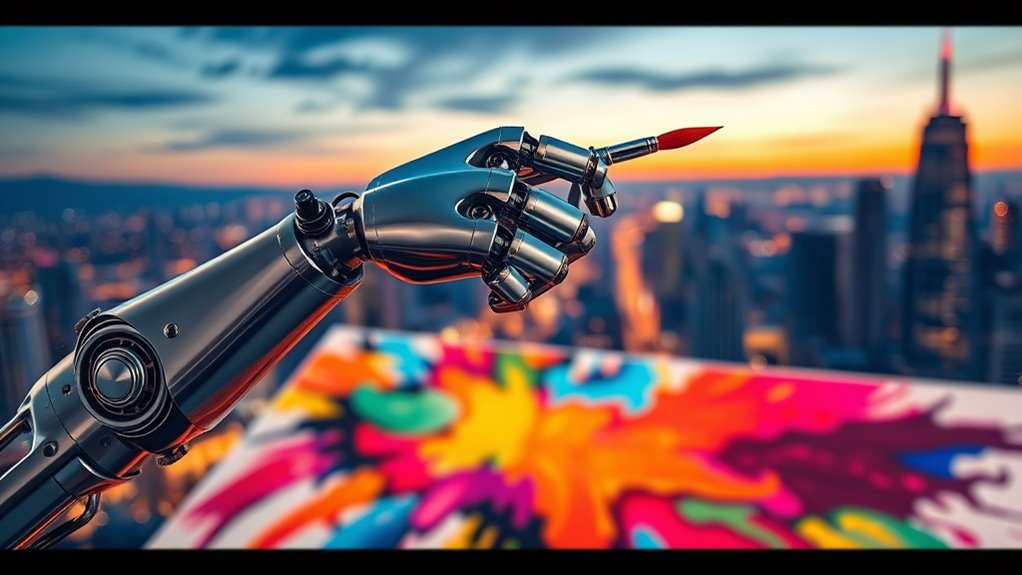
AI is revolutionizing the content creation environment by augmenting human creativity with its ability to automate repetitive tasks, provide data-driven insights, and generate innovative content. By streamlining workflows and refining their craft, creators can focus on high-level thinking and imaginative storytelling. AI-driven data analysis and personalization enable customized content that resonates with target audiences, as AI-powered tools blur the lines between human and artificial creativity. As AI continues to reshape the content environment, new forms of storytelling emerge, and the possibilities for creative expression expand – and the future of content creation holds even more exciting transformations to come.
AI Takes Over Repetitive Tasks
As AI takes over repetitive tasks, content creators can redirect their attention to developing innovative concepts, crafting compelling narratives, and refining their artistic vision. By streamlining workflow and eliminating tedious tasks, AI enables content creators to enhance their craft, increase productivity, and drive business results. With AI efficiency, workflow optimization, and task automation, the future of content creation looks brighter than ever.
Human Creativity Gets a Boost
With the tedious tasks out of the way, content creators can now focus on what truly matters: nurturing their creative potential. This newfound freedom allows them to tap into their inner sources of inspiration, releasing a torrent of innovative ideas and solutions. The collaboration between human creativity and AI-driven efficiency is a match made in heaven, as it enables content creators to focus on high-level thinking and strategy.
- AI-assisted research and data analysis free up time for inspired brainstorming, allowing content creators to explore new ideas and concepts without being bogged down by mundane tasks.
- Innovative collaboration between humans and AI systems enables the creation of unique and compelling content that resonates with audiences on a deeper level.
- With AI handling the grunt work, content creators can focus on developing their unique voice and style, resulting in more authentic and engaging content.
- The fusion of human creativity and AI-driven technology enables the creation of complex, multimedia content that pushes the boundaries of storytelling and audience engagement.
- As AI takes care of the logistics, content creators can focus on building meaningful connections with their audience, encouraging a sense of community and loyalty that drives long-term success.
Data Analysis Made Easy
Data analysis, an essential component of content creation, has become increasingly efficient with the integration of AI. Smart data processing enables the rapid extraction of relevant information, whereas automation of insights saves time and resources. With AI-driven data analysis, content creators can fast track discovery and focus on high-value tasks that drive creativity and innovation.
Smart Data Processing
How can AI-driven content creation platforms efficiently process the vast amounts of data generated from various sources to extract valuable insights? Smart data processing is the key to revealing the full potential of data analysis. By leveraging advanced algorithms and machine learning capabilities, AI-driven platforms can swiftly process and analyze large datasets to identify patterns, trends, and correlations.
- Data visualization: AI-powered platforms can create interactive and dynamic visualizations to help content creators understand complex data insights and make informed decisions.
- Predictive analytics: By analyzing historical data and real-time insights, AI-driven platforms can predict user behavior, engagement metrics, and trend forecasting, enabling content creators to optimize their content for maximum impact.
- Content optimization: AI-driven platforms can analyze user behavior and sentiment analysis to optimize content for better engagement, relevance, and resonance.
- Audience segmentation: AI-powered platforms can identify and segment target audiences based on their preferences, behavior, and demographics, enabling content creators to tailor their content for specific groups.
- Real-time insights: AI-driven platforms can provide real-time insights into user behavior, allowing content creators to respond swiftly to changes in user engagement and sentiment.
Automation of Insights
One of the most significant benefits of AI-driven content creation platforms is their ability to automate the insights generation process, making data analysis a seamless and efficient task. This automation enables content creators to focus on high-value tasks, such as strategy and creative direction, rather than getting bogged down in manual data analysis. With AI-powered data visualization, complex data sets are transformed into actionable insights, allowing creators to identify trends, patterns, and correlations that inform their content strategy. Moreover, predictive analytics integrated into these platforms enable creators to forecast audience engagement, sentiment, and behavior, allowing for data-driven decision-making. This fusion of AI and creativity empowers content creators to develop targeted, personalized content that resonates with their audience, driving engagement and conversion. By automating insights generation, AI-driven platforms reveal new levels of efficiency, productivity, and creativity, revolutionizing the content creation process.
Fast Track Discovery
The creative process often gets stifled by the tedious task of sifting through vast amounts of data, searching for meaningful connections and patterns. This is where Fast Track Discovery comes in – a game-changing approach that streamlines data analysis, empowering creatives to focus on what matters most: crafting compelling content.
Fast Track Discovery leverages AI to hasten the process of identifying trends, patterns, and insights within large datasets. This enables content creators to:
- Quickly identify emerging trends and capitalize on them
- Pinpoint high-performing content formats and topics
- Uncover hidden connections between data points, revealing new opportunities
- Automate content curation, freeing up time for strategic decision-making
- Improve trend identification, staying ahead of the competition
Personalization at Scale Achieved
Seventy percent of today's consumers expect personalized interactions with brands, and AI-driven content creation tools are rising to meet this demand. With the ability to process vast amounts of data, AI-driven solutions can create dynamic customization at an unprecedented scale. This shift towards personalization is revolutionizing the way brands connect with their audiences, cultivating deeper audience engagement and driving meaningful interactions.
By utilizing AI-driven content creation tools, brands can now tailor their messaging to specific demographics, preferences, and behaviors. This level of precision enables the creation of highly targeted content that resonates with individual consumers, increasing the likelihood of conversion and loyalty. Furthermore, AI-driven personalization enables brands to respond to changing consumer preferences in real-time, ensuring that their messaging remains relevant and effective.
The implications of AI-driven personalization at scale are far-reaching, enabling brands to build stronger relationships with their customers, drive revenue growth, and gain a competitive edge in the market. As the demand for personalized experiences continues to escalate, AI-driven content creation tools are poised to play a pivotal role in shaping the future of brand-consumer interactions. By utilizing the capabilities of AI, brands can unlock new levels of audience engagement, driving business success and long-term sustainability.
Machines Learn to Write
Machines are increasingly capable of recognizing and replicating language patterns, unfastening the potential for AI-generated content that mimics human writing styles. Algorithmic storytelling is on the rise, with AI systems able to construct narratives that are coherent, engaging, and even emotionally resonant. As machines learn to write, the boundaries between human and artificial creativity begin to blur.
Language Patterns Unlocked
Language patterns, once thought to be the exclusive domain of human creativity, have been revealed by advanced artificial intelligence. This breakthrough has enabled machines to learn and replicate the intricacies of human language, revolutionizing the way we approach content creation.
Through language evolution and semantic analysis, AI-powered systems can now identify, analyze, and generate language patterns that were previously unique to human writers. This capability has far-reaching implications for industries such as marketing, journalism, and education.
- AI-generated content can be produced at unprecedented scales and speeds, making it an attractive solution for high-volume content needs.
- Machines can analyze and adapt to language trends, ensuring that content remains relevant and engaging.
- AI-powered language tools can assist human writers in refining their craft, freeing them to focus on high-level creative decisions.
- The ability to generate human-like language patterns enables AI systems to create more realistic and immersive experiences in fields such as virtual reality and gaming.
- As AI continues to advance, we can expect to see new forms of language-based innovation that blur the lines between human and machine creativity.
Algorithmic Storytelling Rise
A quarter of a century ago, the notion of artificial intelligence generating compelling narratives was considered the domain of science fiction. Today, machines are not just capable of crafting engaging stories but are likewise revolutionizing the art of storytelling. The rise of algorithmic storytelling marks a significant shift in content creation, as narrative algorithms can now generate unique, data-driven narratives that captivate audiences.
These algorithms can analyze vast amounts of data, identifying patterns and trends that inform the storytelling process. As a result, AI-generated content is becoming increasingly sophisticated, with machines capable of creating complex characters, plot twists, and emotional arcs. Interactive storytelling is likewise on the rise, with AI-powered tools enabling immersive experiences that allow audiences to influence the narrative trajectory.
The implications of algorithmic storytelling are far-reaching, with potential applications in film, literature, and advertising. As machines continue to learn and adapt, the boundaries between human and artificial creativity will blur, giving rise to new forms of innovative storytelling. The future of content creation has never been more exciting, as humans and machines collaborate to push the boundaries of narrative possibility.
Content Generation Goes Mainstream
Several years ago, the notion of AI-generated content was largely confined to experimental projects and novelty applications. Fast-forward to today, and we're witnessing a seismic shift in the content creation arena. AI-powered content generation has gone mainstream, with businesses and individuals alike embracing the technology to streamline their content production workflows.
The benefits are clear: AI-generated content can help alleviate the burden of content creation, freeing up human creatives to focus on higher-level tasks. Automated brainstorming tools, for instance, can generate ideas and concepts at an unprecedented scale and speed, allowing creatives to cherry-pick the best ideas and build upon them. Content curation, too, has become more efficient, with AI capable of sifting through vast amounts of data to surface relevant and engaging content.
Some key developments driving this trend include:
- The proliferation of AI-powered content generation platforms, offering users a range of templates, tools, and features to create high-quality content quickly and easily.
- The increasing sophistication of natural language processing (NLP) and machine learning algorithms, enabling AI systems to generate more nuanced and contextually relevant content.
- The growing demand for high-quality, engaging content, driven by the rise of social media and the need for businesses to establish a strong online presence.
- The need for brands to personalize their content and tailor it to specific audience segments, which AI is well-suited to handle.
- The emergence of new business models and revenue streams, such as AI-generated content subscription services and content-as-a-service platforms.
New Forms of Storytelling Emerge
In the domain of content creation, AI has opened unprecedented opportunities for innovative storytelling. The fusion of human creativity and artificial intelligence has given rise to novel forms of narrative expression, revolutionizing the way stories are told and experienced. Immersive experiences, enabled by virtual and augmented reality, now allow audiences to step into the narrative, promoting emotional engagement and participation. Interactive narratives, where the audience's choices influence the storyline, have become increasingly popular, allowing for a deeper connection with the content.
Transmedia storytelling, which spans multiple platforms and formats, has been transformed by AI as well. The technology enables the creation of complex, branching storylines that can be customized to individual preferences, ensuring a unique experience for each audience member. In addition, AI-driven collective storytelling allows for the integration of diverse cultural influences, resulting in richer, more nuanced narratives. The boundaries between creator and consumer are blurring, as audiences become co-creators, shaping the narrative through their interactions. As AI continues to evolve, we can expect even more innovative forms of storytelling to emerge, additionally redefining the content creation environment.
Collaboration Between Humans and AI
Collaboration between humans and AI in content creation enables the development of innovative content forms, where AI-assisted content generation accelerates the production process, and human-AI creative synergy nurtures unique narratives and perspectives. This synergy allows humans to focus on high-level creative decisions as AI handles more mundane tasks, freeing up time for creative exploration. As a result, the collaboration yields content that is both imaginative and efficient, pushing the boundaries of storytelling and content creation.
AI-Assisted Content Generation
Two decades of artificial intelligence (AI) advancements have paved the way for a new era of content creation, where humans and machines collaborate to produce high-quality content. AI-assisted content generation has become a significant aspect of this collaboration, enabling the creation of engaging, personalized, and data-driven content at scale.
- AI-driven content curation helps identify and refine content that resonates with target audiences, guaranteeing higher audience engagement and brand loyalty.
- Creative augmentation capabilities of AI facilitate the development of innovative narrative structures, visual storytelling, and content strategies that captivate and persuade.
- AI-powered trend analysis provides valuable insights, allowing content creators to craft messages that align with current market sentiments and consumer preferences.
- By automating routine tasks, AI-assisted content generation frees human creatives to focus on high-value tasks, such as developing brand voice and tone, and refining content strategy.
- As AI ethics continue to evolve, it is vital to guarantee that AI-assisted content generation prioritizes transparency, accountability, and respect for diverse perspectives, in the end elevating the quality and impact of collaborative content creation.
Human-AI Creative Synergy
As AI-assisted content generation continues to refine its capabilities, the next frontier of innovation lies in the harmonious convergence of human creativity and artificial intelligence. This fusion, known as Human-AI Creative Synergy, opens up unprecedented opportunities for content creators. By combining the strengths of both parties, humans and AI can collaborate to produce innovative, high-quality content that resonates with audiences.
Collaborative brainstorming sessions can now be augmented with AI-driven idea generation, allowing humans to focus on creative ideation and strategic direction. AI can process vast amounts of data to identify patterns, trends, and insights, which humans can then use to craft compelling narratives and messaging. This synergy enables content creators to work more efficiently, effectively, and creatively, resulting in engaging, personalized, and impactful content that drives business results. As Human-AI Creative Synergy continues to evolve, it will transform the content creation environment, empowering creators to push the boundaries of what is possible.
The Rise of AI-Powered Tools
Through the lens of technological advancements, the creative environment has undergone a significant transformation, with AI-powered tools emerging as a driving force behind this change. The integration of AI innovation in content creation has led to a paradigm shift, enabling creatives to focus on high-level strategy and ideation during automating mundane tasks.
AI-powered tools have transformed content optimization, allowing for real-time analysis and improvement of user engagement. This digital transformation has opened up new avenues for creative collaboration, enabling teams to work together seamlessly across geographical boundaries.
Some key benefits of AI-powered tools in content creation include:
- Efficiency improvement: AI-powered tools automate repetitive tasks, freeing up time for creatives to focus on high-impact activities.
- Content strategy refinement: AI-driven insights enable data-backed content decisions, leading to more effective audience targeting.
- Tool accessibility: AI-powered tools have democratized access to advanced technology, leveling the playing field for creatives of all sizes.
- Real-time feedback: AI-powered analytics provide instant feedback, enabling rapid iteration and improvement.
- Scalability: AI-powered tools can handle large volumes of data, making them an ideal solution for high-volume content creation.
Unleashing the Creative Potential
By embracing AI-powered tools, creatives can now redirect their focus in the direction of high-level ideation, freeing themselves from the constraints of tedious, time-consuming tasks. This liberation enables creatives to plunge deeper into creative exploration, nurturing imaginative collaboration and innovative expression. Artistic experimentation becomes more accessible, as AI-assisted inspiration sources spark new ideas and perspectives.
As design evolution accelerates, visual storytelling takes center stage, with AI-driven narrative enhancement amplifying emotional resonance. The ideation processes are streamlined, allowing creatives to iterate and refine their concepts with unprecedented speed and precision. This synergy between human creativity and AI capabilities opens new avenues for artistic expression, as creatives can now focus on the essence of their craft.
With AI handling the mundane, creatives can redirect their energy towards conceptualizing bold, innovative ideas that captivate and resonate with their audience. The fusion of human imagination and AI-driven insights gives rise to fresh, groundbreaking content that pushes the boundaries of storytelling. As a result, creatives can tap into the full spectrum of their creative potential, releasing a new wave of innovative and impactful content that leaves a lasting impression.
Frequently Asked Questions
Can AI Truly Replace Human Creatives in Content Generation?
According to a recent study, 80% of marketers believe AI-generated content will surpass human-created content in the next five years. Nonetheless, can AI truly replace human creatives in content generation? Although AI excels in data-driven tasks, it falls short in creative vision and emotional intelligence, highlighting AI limitations. The future of content creation lies in creative collaboration, where humans and AI work together to produce innovative and engaging content that resonates with audiences.
How Do I Integrate AI Tools Into My Existing Workflow?
To seamlessly integrate AI tools into your existing workflow, adopt a strategic approach. Identify areas where AI can improve human capabilities, then select tools that align with your content goals. Implement AI integration strategies that streamline tasks, automate repetitive processes, and boost collaboration. Focus on workflow optimization to maximize efficiency and minimize disruption. By doing so, you'll reveal the full potential of AI-driven content creation, amplifying your team's productivity and creativity.
Will Ai-Generated Content Be Indistinguishable From Human-Created Content?
The prospect of AI-generated content becoming indistinguishable from human-created content raises intriguing questions about style comparison and quality assessment. As AI algorithms advance, they may replicate human creativity, making it challenging to discern the origin of content. Nevertheless, subtle differences in tone, nuance, and emotional resonance may still betray AI authorship. In the end, the key to indistinguishability lies in AI's ability to capture the intricacies and inconsistencies that make human-created content unique.
Can AI Help With Content Localization and Cultural Adaptation?
It's no coincidence that the most effective global content strategies prioritize cultural relevance. AI can greatly aid in content localization and cultural adaptation by perfecting language nuances and ensuring cultural sensitivity. By analyzing cultural data and identifying regional preferences, AI-generated content can be customized to resonate with diverse audiences. This fusion of technology and cultural insight enables brands to transcend geographical boundaries, nurturing meaningful connections with customers worldwide.
What Are the Copyright Implications of Ai-Generated Content?
As AI-generated content proliferates, copyright implications emerge as a pressing concern. A significant question arises: who owns the copyright to AI-created works? The answer lies in a gray area, sparking ethical considerations. Should the creator of the AI system be deemed the copyright owner, or does the AI itself possess creative agency? Clarifying copyright ownership is fundamental to guarantee fair compensation and protection of intellectual property rights, in the end influencing the future of AI-driven content creation.

