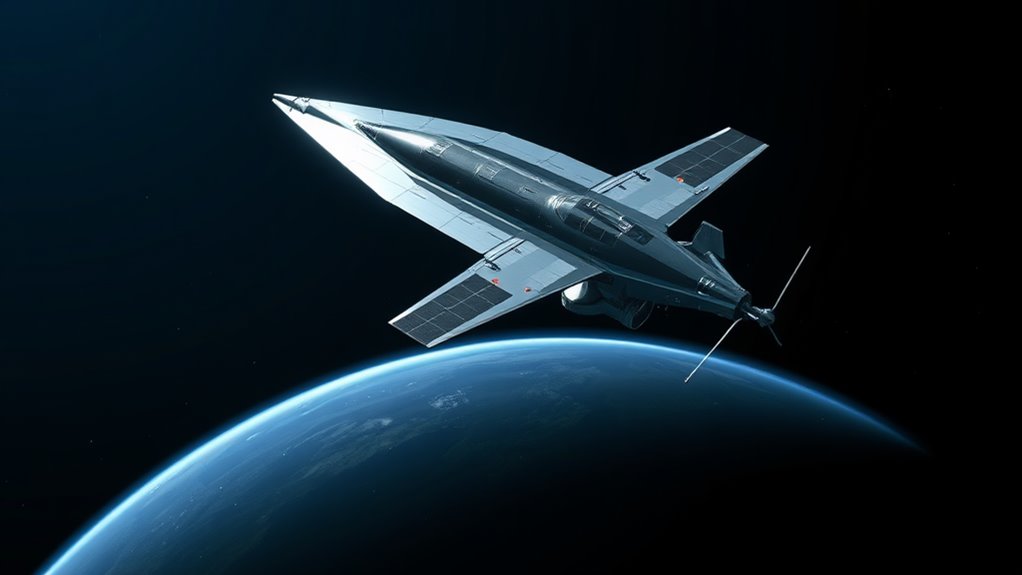
Space technology is driving a transformative shift in the exploration of space, enabling humanity to venture further, faster, and more sustainably than ever before. Breakthroughs in advanced propulsion and navigation systems, such as next-generation ion engines and AI-powered navigation, are revolutionizing space travel. Furthermore, innovations in resource utilization and life support, communication and interoperability, and training and simulation technologies are paving the way for sustainable human presence in space. As we push the boundaries of what's possible, the next era of exploration is set to be defined by unprecedented feats of innovation and discovery, with even more exciting developments on the horizon.
Reusable Rockets Revolutionize Space Travel
Additionally, reusable rockets have revitalized hopes of planetary colonization. By dramatically reducing the cost of launching payloads, humanity can now contemplate large-scale missions to establish permanent settlements on the moon and Mars. This has significant implications for the long-term survival of our species, ensuring that our presence in the universe is not limited to a single planet. As the space industry continues to evolve, one thing is clear: reusable rockets have transformed space travel, opening doors to unprecedented opportunities for exploration and discovery.
AI-Powered Navigation Systems Take Flight
AI-powered navigation systems are transforming space exploration by enabling autonomous route planning, which allows spacecraft to chart their own courses and adjust to changing mission requirements. This capability is further improved by real-time trajectory adjustments, permitting spacecraft to respond to unforeseen obstacles and optimize their paths in real-time. By integrating these advanced navigation capabilities, space agencies and private companies can greatly enhance the efficiency, safety, and success of their missions.
Autonomous Route Planning
Three decades of advancements in computer vision, machine learning, and sensor technologies have converged to enable the development of autonomous route planning systems, which are revolutionizing the field of navigation. These systems utilize AI-powered algorithms to optimize routes, ensuring that spacecraft and satellites reach their destinations efficiently and safely.
Autonomous route planning is particularly vital in space exploration, where communication delays and harsh environmental conditions can render human intervention impossible. By leveraging machine learning and sensor data, autonomous systems can adapt to changing circumstances and navigate through uncharted territories.
Some key benefits of autonomous route planning include:
- Improved fuel efficiency: Optimized routes reduce fuel consumption, enabling longer mission durations and more extensive exploration.
- Enhanced safety: Autonomous systems can detect and respond to hazards in real-time, minimizing the risk of accidents and errors.
- Increased precision: AI-powered navigation enables precise trajectory planning, ensuring that spacecraft and satellites reach their intended targets with accuracy.
Real-Time Trajectory Adjustments
As autonomous route planning systems continue to refine spacecraft and satellite navigation, the next logical step is to facilitate real-time trajectory adjustments. This capability is essential for mission success, as it allows for instantaneous response to changing environmental conditions, unexpected obstacles, or revised mission objectives. AI-driven navigation systems are now equipped to analyze vast amounts of data in real-time, processing complex trajectory optimization techniques to guarantee the most efficient and effective flight path.
Dynamic flight adjustments are made possible through advanced algorithms and machine learning models that can predict and adapt to various scenarios. This enables spacecraft and satellites to make precision adjustments to their trajectory, guaranteeing peak fuel efficiency, reduced risk, and improved overall performance. The ability to make real-time adjustments similarly enables more flexible and responsive mission planning, allowing for rapid adaptation to changing circumstances and maximizing the value of space-based assets. By leveraging the strength of AI-driven navigation, space agencies and commercial operators can unlock new levels of precision, efficiency, and success in their space exploration endeavors.
Advanced Life Support Systems Evolve
As extended space missions and potential human settlements on the Moon or Mars remain a focal point of ongoing space exploration efforts, the development of reliable Advanced Life Support Systems (ALSS) has emerged as a vital component in securing the survival and well-being of astronauts in space. These systems are designed to provide a sustainable habitat for astronauts, supporting their physiological needs in the harsh environment of space.
ALSS encompasses a range of technologies, including air, water, and waste recycling, in addition to food production and waste management. Key advancements in ALSS include:
- Closed-loop life support systems that recycle air, water, and waste, minimizing the need for resupply missions and reducing the environmental impact of space exploration.
- In-situ resource utilization, which enables the extraction of resources from the Martian or lunar environment, such as water and regolith, to support life support systems.
- Bioregenerative systems that utilize living organisms, such as plants and microorganisms, to recycle waste, produce food, and purify air and water.
These advancements are essential for establishing sustainable habitats in space, enabling longer-duration missions and paving the way for human settlements on the Moon and Mars. By pushing the boundaries of ALSS, space agencies and private companies can guarantee the safety and well-being of astronauts, while simultaneously reducing the environmental footprint of space exploration.
Virtual Reality Training for Astronauts
Virtual reality technology is revolutionizing the training paradigm for astronauts, allowing them to prepare for complex space missions in a highly immersive and realistic environment. This innovation enables astronauts to develop critical skills and muscle memory through repeated exposure to simulated spacewalks, emergency scenarios, and other high-stress situations.
| Training Module | Immersive Simulation | Cognitive Training Benefits |
|---|---|---|
| Spacewalk Simulation | Astronauts practice extravehicular activities in a realistic, zero-gravity environment | Improved spatial awareness and situational judgment |
| Emergency Scenario Training | Realistic, high-stress scenarios simulate system failures and emergencies | Enhanced crisis management and decision-making skills |
| Robotics Operation Training | Astronauts practice operating robotic arms and other equipment in a virtual environment | Improved hand-eye coordination and fine motor skills |
| Spacecraft Systems Training | Interactive simulations of spacecraft systems and components | Improved comprehension of complex systems and troubleshooting capabilities |
| Mission Simulation Training | Astronauts rehearse entire missions, from launch to landing, in a highly realistic environment | Improved overall mission readiness and team cohesion |
In-Orbit Assembly and Manufacturing
Several decades of space exploration have demonstrated the importance of in-orbit assembly and manufacturing in enabling complex space missions. The ability to assemble and manufacture components in space has opened up new possibilities for space exploration, allowing for the creation of larger, more complex structures that were previously impossible to launch from Earth.
In-orbit assembly and manufacturing likewise enable the construction of space habitats, which are critical for sustaining human life during long-duration space missions. These habitats can be designed to provide a safe and comfortable environment for astronauts, complete with life support systems, radiation shielding, and artificial gravity.
Some of the key benefits of in-orbit assembly and manufacturing include:
- Modular structures: In-orbit assembly allows for the creation of modular structures that can be easily expanded or modified as needed, providing a high degree of flexibility and adaptability.
- Reduced launch costs: By manufacturing components in space, the need for large, heavy launch vehicles is reduced, resulting in significant cost savings.
- Increased precision: In-orbit assembly and manufacturing enable the creation of highly precise components and structures, which is critical for many space-based applications.
Next-Gen Propulsion Systems Unveiled
Next-generation propulsion systems are revolutionizing space travel, offering unprecedented efficiency and strength. Among these innovations are advanced ion engines, which have undergone significant improvements to provide more thrust during reducing energy consumption. Furthermore, nuclear pulse propulsion is emerging as a promising technology, capable of achieving high speeds during minimizing fuel requirements.
Ion Engines Evolved
Revolutionizing space travel, scientists have made notable breakthroughs in ion engine technology, paving the way for more efficient and sustainable propulsion systems. This advancement is essential for deep space applications, where energy efficiency and prolonged mission durations are paramount. Next-generation ion engines boast notable improvements in thrust, energy, and fuel efficiency, making them ideal for long-duration missions.
Key features of these evolved ion engines include:
- Advanced ionization: Novel techniques for ionizing propellants, resulting in higher thrust-to-energy ratios and increased efficiency.
- High-energy electricity: Advanced power processing units enable higher energy output, allowing for greater thrust and faster mission timelines.
- In-orbit reconfigurability: Modular designs enable real-time adjustments to engine performance, ensuring peak operation in diverse mission scenarios.
These innovations will considerably improve the capabilities of spacecraft, enabling them to travel farther, faster, and more efficiently. As the space industry continues to push the boundaries of exploration, these advanced ion engines will play a vital role in propelling humanity deeper into the cosmos.
Nuclear Pulse Propulsion
Beyond the domain of ion engines, a new frontier of propulsion systems is emerging, with nuclear pulse propulsion taking center stage as a game-changer in deep space exploration. This revolutionary technology utilizes the immense energy released by nuclear reactions to propel spacecraft at unprecedented speeds. By detonating small nuclear bombs in a controlled environment, nuclear pulse propulsion generates a series of high-energy pulses that accelerate the spacecraft to remarkable velocities.
The key advantage of nuclear pulse propulsion lies in its unparalleled propulsion efficiency. By capitalizing on the immense energy density of nuclear fuel, this technology enables spacecraft to travel farther and faster than ever before, making interstellar expeditions a tantalizing possibility. Additionally, nuclear pulse propulsion offers a significant increase in thrust-to-weight ratio, allowing for more efficient use of resources and reduced mission duration. As the space industry continues to push the boundaries of exploration, nuclear pulse propulsion is poised to play a pivotal role in shaping the next era of deep space travel.
Space-Based Solar Power Generation
Approximately 173,000 terawatts of solar energy strike the Earth's surface daily, yet only a fraction of it is utilized. This immense energy potential has sparked interest in space-based solar energy generation, a revolutionary concept that could transform the way we capture energy.
Space-based solar energy systems involve deploying solar panels in orbit around the Earth, where they can capture a constant and intense flow of solar energy. This energy is then converted into microwave beams and transmitted back to the planet, providing a clean and sustainable source of energy.
The advantages of space-based solar energy generation are numerous:
- Uninterrupted Energy Supply: Solar panels in orbit can collect energy 24/7, unaffected by weather patterns or seasonal changes.
- Increased Energy Yield: Space-based solar panels can capture more energy than their terrestrial counterparts, thanks to the Earth's atmospheric interference.
- Reduced Environmental Impact: By collecting energy in space, we can reduce our reliance on fossil fuels and mitigate the environmental consequences of traditional energy generation.
Advances in solar panel technology have made space-based solar energy generation more feasible than ever. As the demand for sustainable energy solutions continues to grow, this innovative approach could play an essential role in shaping the future of energy generation.
In-Situ Resource Utilization Strategies
Space exploration and habitation rely heavily on the efficient use of resources, and in-situ resource utilization (ISRU) strategies have emerged as a crucial component of space mission planning. By utilizing local resources, space agencies and private companies can reduce reliance on resupply missions from Earth, thereby cutting costs and enhancing mission sustainability.
ISRU strategies encompass a range of technologies, including resource extraction, habitat construction, and atmospheric processing. For instance, lunar or planetary regolith can be extracted for mineral refinement, providing important resources for fuel production, energy generation, and habitat construction. Water harvesting from lunar or planetary surfaces can support life support systems, whereas atmospheric processing enables the production of breathable air and other crucial resources.
Agricultural sustainability is equally critical, with ISRU strategies enabling the growth of food crops in controlled environments. Environmental monitoring systems track resource utilization, waste recycling, and pollution levels, ensuring a sustainable presence in space. By utilizing local resources, space-faring nations can establish a sustainable presence in space, paving the way for long-duration missions and, eventually, human settlements. As space exploration continues to push the boundaries of what is possible, ISRU strategies will play an increasingly crucial role in shaping the future of space habitation and exploration.
Robust Communication Networks Launched
The establishment of robust communication networks is a vital milestone in space exploration, enabling seamless data exchange between Earth and spacecraft. To achieve this, satellite constellations have been launched to provide global coverage and redundancy, ensuring uninterrupted communication. In addition, interoperable network standards have been developed to facilitate seamless data transfer between different space agencies and organizations.
Satellite Constellations Unite
Orbiting the Earth, a network of interconnected satellites has formed a robust communication backbone, enabling seamless data exchange across the globe. This satellite synergy has bridged the digital divide, cultivating global connectivity and empowering industries to thrive in an era of rapid technological advancements.
The unification of satellite constellations has brought about a paradigm shift in data transmission, offering:
- Enhanced Coverage: Satellites can now provide internet access to remote and underserved regions, bridging the gap in global connectivity.
- Increased Redundancy: Interconnected satellites guarantee that data transmission remains uninterrupted, even in the event of satellite failure or maintenance.
- Improved Latency: Satellite constellations enable faster data exchange, reducing latency and facilitating real-time communication.
As the satellite constellation ecosystem continues to evolve, it is poised to transform the way we communicate, conduct business, and explore the vast expanse of space.
Interoperable Network Standards
As satellite constellations continue to proliferate, the need for seamless communication between them has become increasingly imperative. This has led to a growing emphasis on interoperable network standards, enabling disparate systems to communicate effectively and efficiently.
| Network Protocol | Interoperable Interface |
|---|---|
| TCP/IP | Open Standard |
| HTTP | RESTful API |
| MQTT | Lightweight IoT |
Robust communication networks require standardized interfaces and protocols to guarantee seamless data exchange. Interoperable interfaces, such as open standards and RESTful APIs, enable satellite constellations to communicate with each other without proprietary restrictions. Network protocols like TCP/IP and MQTT facilitate efficient data transfer, reducing latency and increasing overall network performance. By adopting these standards, satellite operators can guarantee seamless communication, increased reliability, and reduced system complexity. This, in turn, enables more efficient use of resources, improved decision-making, and accelerated progress in space exploration.
Biomedical Breakthroughs in Space Medicine
How can space exploration, with its harsh environment and limited resources, drive innovation in medical research and treatment? The answer lies in the unique challenges posed by space travel, which have led to groundbreaking discoveries and advancements in space medicine. One of the most significant areas of research is the study of microgravity effects on the human body. Prolonged exposure to microgravity can cause a range of health problems, including muscle and bone loss, vision impairment, and cardiovascular issues. By comprehending these effects, scientists can develop new treatments and therapies for conditions that affect people on Earth, such as osteoporosis and vision disorders.
The space environment has additionally accelerated telemedicine advancements, enabling remote monitoring and real-time communication between medical professionals and astronauts. This technology has far-reaching implications for terrestrial healthcare, where remote or underserved communities can benefit from virtual medical consultations and remote monitoring.
Some notable biomedical breakthroughs in space medicine include:
- Development of portable, wearable devices for real-time health monitoring
- Advances in 3D printing and bioprinting for tissue engineering and regenerative medicine
- Research into the effects of microgravity on the human microbiome, with potential applications for comprehending and treating infectious diseases.
Frequently Asked Questions
How Will Space Exploration Affect the Earth's Environment?
As the celestial canvas of our existence unfolds, the echoes of space exploration resonate back to our terrestrial home. The environmental impact of this pursuit is a pressing concern. Climate monitoring from space will grant us unprecedented insights, enabling data-driven decisions to mitigate the effects of climate change. Furthermore, resource management in space will serve as a blueprint for sustainable practices on Earth, illuminating a path in the direction of a harmonious coexistence with our planet.
Will Humans Establish Permanent Settlements on Other Planets?
As humanity ventures further into the cosmos, the prospect of establishing permanent settlements on other planets becomes increasingly viable. Colonization strategies are being developed to guarantee habitat sustainability, addressing vital aspects such as resource management, radiation protection, and self-sufficiency. By overcoming these challenges, humans can create thriving extraterrestrial communities, paving the way for a multi-planetary society.
Can Space Technology Solve Global Energy Crises?
As the world's energy terrain hangs precariously in the balance, a beacon of hope emerges on the horizon. Can space technology solve global energy crises? The answer lies in utilizing the infinite strength of the cosmos. By leveraging solar energy and releasing new energy resources, space tech can transform our planet's energy infrastructure. Envision a future where energy scarcity is a relic of the past, and humanity thrives on a sustainable, limitless energy supply.
Will Space Tourism Become Accessible to the General Public?
As the private space industry continues to advance, the prospect of accessible space tourism for the general public is increasingly plausible. Commercial ventures are driving innovation, making affordable travel to space a reality. With companies like Virgin Galactic and SpaceX leading the charge, the cost of space travel is decreasing, paving the way for a new generation of space enthusiasts to experience the thrill of weightlessness.
What Are the Potential Risks of Relying on AI in Space Travel?
As we venture into the unknown, reliance on AI in space travel sparks both excitement and trepidation. On one hand, AI's precision and speed can transform navigation and data analysis. On the other, AI limitations and Ethical concerns loom large. What if AI misinterprets critical data or prioritizes efficiency over human life? As we entrust AI with our cosmic endeavors, we must acknowledge and address these risks to guarantee that our pursuit of progress doesn't compromise our values or safety.

