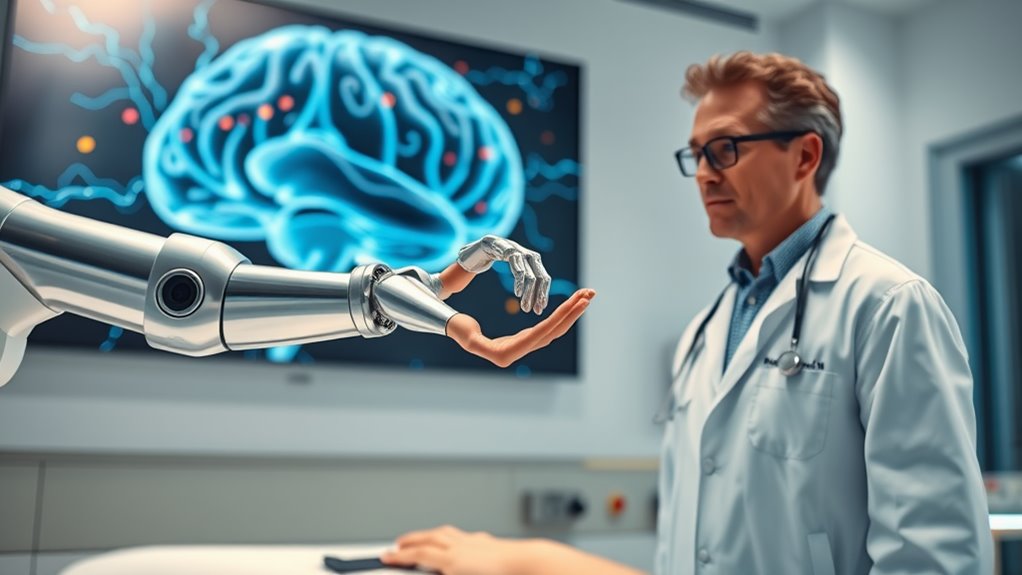
AI is revolutionizing healthcare by transforming diagnostic accuracy, patient care, and clinical workflows through its ability to process vast amounts of data, provide personalized treatment options, and optimize resource allocation. AI-driven diagnosis and treatment enable precise predictions, reducing errors in complex medical conditions. Furthermore, AI amplifies patient experience through telehealth advancements, personalized health advice, and emotional support. By streamlining clinical workflows, AI automates administrative tasks, reduces clinician workload, and improves overall care quality. As AI continues to advance, its impact on healthcare will only continue to grow, revealing new opportunities for innovation and enhancement.
AI-Driven Diagnosis and Treatment
The convergence of artificial intelligence and healthcare has transformed the diagnostic environment, enabling clinicians to accurately identify and treat complex medical conditions with unprecedented speed and precision. AI-driven diagnosis and treatment have become indispensable tools in the medical arsenal, empowering healthcare professionals to make data-driven decisions that improve patient outcomes.
Machine learning algorithms are at the heart of this revolution, allowing for the analysis of vast amounts of medical data to identify patterns and predict patient trajectories. These algorithms can detect subtle abnormalities in medical images, such as tumors or fractures, with a level of accuracy that surpasses human capabilities. Predictive analytics, in turn, enable clinicians to anticipate patient responses to different treatment options, ensuring that personalized care is delivered with precision.
The impact of AI-driven diagnosis and treatment is far-reaching, from reducing diagnosis errors to streamlining clinical workflows. By automating routine tasks and freeing up clinicians to focus on high-value tasks, AI is optimizing healthcare resource allocation and enhancing the overall quality of care. As the healthcare arena continues to evolve, the role of AI in diagnosis and treatment will become increasingly pivotal, driving innovation and improving patient lives.
Enhancing Patient Experience and Care
Beyond the clinical benefits of AI-driven diagnosis and treatment, the technology is also poised to transform the patient experience. By leveraging telehealth advancements, AI can facilitate remote consultations, reducing wait times and increasing access to care for patients in underserved or remote areas. This shift in the direction of virtual care enables healthcare providers to deliver personalized, patient-centric services that cater to individual needs and preferences.
AI-driven patient engagement platforms can likewise promote meaningful interactions between patients and healthcare professionals. These platforms use natural language processing and machine learning algorithms to offer personalized health advice, treatment plans, and medication reminders, empowering patients to take an active role in their care. Additionally, AI-powered chatbots can provide emotional support and address concerns, alleviating anxiety and stress associated with healthcare experiences.
The data-driven insights generated by AI can help healthcare providers identify areas for improvement, enabling them to design targeted interventions that improve patient satisfaction and outcomes. By streamlining administrative tasks and reducing paperwork, AI can free up healthcare professionals to focus on what matters most – delivering compassionate, high-quality care that prioritizes the patient's needs and experience. As AI continues to evolve, its potential to transform patient care and experience will only continue to grow.
Streamlining Clinical Workflows Efficiently
Frequently, inefficient clinical workflows hinder healthcare providers from delivering high-quality patient care, wasting valuable resources and time. This is where artificial intelligence (AI) intervenes, transforming healthcare by streamlining clinical workflows efficiently. AI-driven systems automate and optimize administrative tasks, reducing the burden on healthcare professionals and allowing them to focus on patient care.
AI-driven telehealth integration enables remote patient monitoring, reducing hospital readmissions and improving health outcomes. Additionally, AI-driven data management systems process and analyze vast amounts of clinical data, providing actionable insights that inform treatment decisions and improve patient care. By automating routine tasks, such as data entry and claims processing, AI frees up healthcare professionals to focus on high-value tasks that require human expertise and empathy.
Moreover, AI-driven workflows enable real-time tracking and analysis of patient data, facilitating timely interventions and improving patient outcomes. By streamlining clinical workflows, AI helps healthcare providers reduce costs, boost productivity, and improve patient satisfaction. As AI continues to evolve, its potential to transform healthcare delivery is vast, enabling healthcare providers to deliver high-quality, patient-centered care efficiently and effectively. By utilizing the capabilities of AI, healthcare providers can transform clinical workflows, ultimately leading to better health outcomes and improved patient care.
Addressing Healthcare Inefficiencies Effectively
AI's ability to streamline clinical workflows efficiently has a direct impact on addressing healthcare inefficiencies effectively. By automating routine tasks and freeing up clinicians' time, AI enables healthcare providers to focus on high-value tasks that drive better patient outcomes. Healthcare automation, fueled by AI, optimizes resource allocation, reducing waste and improving productivity.
Predictive analytics, a key aspect of AI, helps identify inefficiencies in healthcare systems. By analyzing vast amounts of data, AI-fueled predictive models can pinpoint areas of waste, inefficiency, and variability, enabling healthcare leaders to make data-driven decisions to address these issues. This leads to improved resource utilization, reduced costs, and improved patient care.
AI-driven automation additionally helps reduce medical errors, a significant contributor to healthcare inefficiencies. By automating tasks such as medication administration, AI minimizes the risk of human error, ensuring that patients receive the right treatment at the right time. Moreover, AI-fueled clinical decision support systems provide clinicians with real-time guidance, enabling them to make informed decisions that reduce unnecessary tests, procedures, and hospitalizations.
The Future of Personalized Medicine
One of the most promising applications of AI in healthcare is its potential to transform personalized medicine. With the ability to process vast amounts of data, AI can help tailor treatment plans to individual patients' unique genetic profiles, medical histories, and lifestyle factors.
By utilizing machine learning algorithms, healthcare professionals can:
- Analyze genomic data: AI can quickly process genetic information to identify potential risk factors and susceptibility to certain diseases, enabling early intervention and prevention strategies.
- Optimize treatment plans: AI can analyze patient data to identify the most effective treatment options, reducing trial-and-error approaches and improving health outcomes.
- Predict patient responses: AI can forecast how individual patients will respond to different treatments, allowing for more targeted and effective care.
- Identify new treatment opportunities: AI can uncover new correlations between genetic markers and diseases, leading to the development of novel therapies and treatments.
Through AI-driven personalized medicine, healthcare providers can deliver more precise, effective, and efficient care, leading to better patient outcomes and improved quality of life. By utilizing the strength of AI, we can release the full potential of genetic profiling and treatment optimization, revolutionizing the future of healthcare.
Frequently Asked Questions
Can AI Replace Human Doctors in Healthcare?
Can AI supplant human doctors in healthcare? Although AI capabilities have advanced exponentially, replicating the intricacies of doctor-patient dynamics is a formidable task. AI systems lack the emotional intelligence, empathy, and nuanced decision-making that human doctors bring to the table. AI can augment doctors' capabilities, but replacing them entirely is unlikely. The complex interplay between patients and doctors requires a human touch, making AI a valuable tool, not a replacement, in the healthcare ecosystem.
How Does AI Handle Rare Medical Conditions?
In the vast expanse of medical mysteries, rare diseases lurk like hidden islands, waiting to be charted. AI's advanced navigation systems can pinpoint these elusive conditions, illuminating the path to accurate rare disease diagnosis. By analyzing vast datasets, AI-driven treatments can be customized to each patient's unique needs, offering a beacon of hope to those lost in the wilderness of uncertainty.
Will AI Exacerbate Existing Healthcare Disparities?
The indiscriminate adoption of AI in healthcare raises concerns about exacerbating existing disparities. If AI systems are primarily designed for and validated on majority populations, they may perpetuate biases and worsen health outcomes for marginalized groups. Additionally, limited AI accessibility in underserved areas can further entrench health inequities. To mitigate this, policymakers must prioritize health equity by ensuring AI development is inclusive, culturally sensitive, and aimed at reducing disparities.
Can AI Ensure Data Privacy in Healthcare?
Ensuring data privacy is a paramount concern in healthcare, and AI can play an important role in this endeavor. By leveraging advanced data encryption methods, AI can safeguard sensitive patient information from unauthorized access. Nevertheless, it is vital to obtain explicit patient consent before collecting and processing their data. Transparency and accountability are key to building trust in AI-driven healthcare systems.
Will AI Increase Healthcare Costs in the Long Run?
As healthcare systems navigate the intricacies of technology adoption, a pivotal concern emerges: will the integration of AI drive up costs in the long run? Although AI may necessitate significant upfront investments, its potential to improve cost efficiency through streamlined processes, reduced errors, and optimized resource allocation can eventually yield significant savings. By leveraging AI's capabilities, healthcare providers can redirect resources in the direction of high-value care, improving patient outcomes as they alleviate the financial burden.

